
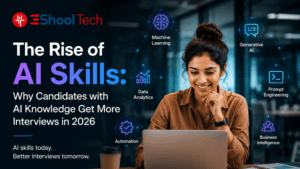
 Artificial Intelligence (AI) is no longer limited to data scientists and machine learning engineers. In 2026, AI skills have become valuable across nearly every industry, from software development and marketing to finance, healthcare, and human resources.
As organizations accelerate digital transformation and AI adoption, employers are actively seeking professionals who can work alongside AI technologies, automate processes, analyze data, and drive innovation.
Candidates with AI knowledge are receiving more interview opportunities, commanding higher salaries, and gaining a competitive edge in the job market.
In this article, we’ll explore why AI skills are becoming essential, which AI skills employers value most, and how professionals can prepare for the future of work.
Why AI Skills Are in High Demand
Businesses are investing heavily in AI to improve productivity, reduce costs, enhance customer experiences, and gain competitive advantages.
Organizations need employees who can:
- Understand AI tools and technologies
- Automate repetitive tasks
- Improve business efficiency
- Work with AI-driven systems
- Analyze and interpret data
- Support AI implementation projects
As a result, recruiters increasingly prioritize candidates who demonstrate AI literacy and practical AI-related skills.
The Growing Impact of AI Across Industries
AI is transforming nearly every business function.
Information Technology
- Software development automation
- AI-assisted coding
- Cloud optimization
- Intelligent testing
Human Resources
- AI-powered recruitment
- Candidate screening
- Workforce analytics
Marketing
- Content generation
- Customer segmentation
- Campaign optimization
- Predictive analytics
Finance
- Fraud detection
- Risk assessment
- Financial forecasting
Healthcare
- Medical diagnostics
- Patient monitoring
- Administrative automation
Professionals who understand how AI supports these functions are becoming increasingly valuable to employers.
Why Candidates with AI Skills Get More Interviews
1. AI Skills Signal Future Readiness
Employers want candidates who can adapt to technological change.
When recruiters see AI skills on a resume, it demonstrates:
- Continuous learning
- Technical adaptability
- Innovation mindset
- Future-focused thinking
These qualities make candidates stand out in competitive hiring processes.
2. Companies Need AI Adoption Champions
Many organizations are implementing AI but lack employees who understand how to use it effectively.
Candidates with AI knowledge can help:
- Identify automation opportunities
- Improve workflows
- Increase productivity
- Support digital transformation initiatives
This makes them highly attractive to hiring managers.
3. AI Skills Improve Productivity
Employers are looking for professionals who can achieve more with fewer resources.
AI-enabled employees can:
- Automate routine tasks
- Generate reports faster
- Analyze data efficiently
- Improve decision-making
Recruiters recognize that these capabilities contribute directly to business performance.
4. AI Knowledge Is Valuable Across Job Roles
You don’t need to become an AI engineer to benefit from AI skills.
Today, employers value AI knowledge in:
- Software Developers
- Project Managers
- Business Analysts
- Recruiters
- HR Professionals
- Marketers
- Sales Executives
- Operations Managers
Even basic AI proficiency can significantly improve interview opportunities.
Most In-Demand AI Skills in 2026
Generative AI
Employers are seeking professionals who understand tools such as:
- ChatGPT
- Gemini
- Copilot
- Claude
Key applications include:
- Content creation
- Research
- Workflow automation
- Customer support
Prompt Engineering
Prompt engineering has become an important skill for maximizing AI outputs.
Professionals who can create effective prompts often achieve better productivity and business outcomes.
Machine Learning Fundamentals
Understanding machine learning concepts helps professionals:
- Interpret AI outputs
- Collaborate with technical teams
- Participate in AI projects
Even non-technical professionals benefit from foundational knowledge.
Data Analysis and Visualization
AI relies on quality data.
Skills in:
- Data interpretation
- Business intelligence
- Analytics tools
- Dashboard creation
continue to be highly valued across industries.
Automation Tools
Organizations increasingly use automation platforms such as:
- Microsoft Power Automate
- Zapier
- UiPath
Candidates who understand workflow automation gain a significant advantage.
Top AI-Related Roles Hiring in 2026
Technical Roles
- AI Engineer
- Machine Learning Engineer
- Data Scientist
- MLOps Engineer
- AI Product Manager
- Automation Engineer
Non-Technical Roles
- AI Business Analyst
- AI Recruiter
- Digital Transformation Consultant
- AI Project Coordinator
- AI Marketing Specialist
The demand for both technical and business-focused AI professionals continues to grow.
How Professionals Can Develop AI Skills
Learn AI Fundamentals
Start by understanding:
- Artificial Intelligence
- Machine Learning
- Generative AI
- Automation
A strong foundation helps professionals adapt to evolving technologies.
Use AI Tools Daily
Hands-on experience is one of the most effective ways to build AI expertise.
Practice using:
- ChatGPT
- Gemini
- Microsoft Copilot
- AI productivity tools
Employers value practical experience more than theoretical knowledge alone.
Earn Industry Certifications
Certifications demonstrate commitment to professional growth.
Popular options include:
- AI Fundamentals Certifications
- Cloud AI Certifications
- Data Analytics Programs
- Automation Certifications
These credentials can strengthen resumes and improve interview opportunities.
Build AI Projects
Creating real-world projects helps candidates showcase their skills.
Examples include:
- Workflow automation projects
- AI-generated content systems
- Data analysis dashboards
- AI-powered business solutions
Practical demonstrations often impress employers more than certifications alone.
How Recruiters Evaluate AI Skills
Recruiters typically assess:
Technical Understanding
Can the candidate explain AI concepts clearly?
Practical Application
Has the candidate used AI to solve business problems?
Adaptability
Can the candidate learn and adopt new technologies quickly?
Business Impact
Does the candidate understand how AI creates value for organizations?
Candidates who combine technical knowledge with business understanding often perform best during interviews.
What AI Skills Will Be Most Valuable by 2027?
Experts predict growing demand for:
- Generative AI
- Prompt Engineering
- AI Automation
- Data Analytics
- Machine Learning
- AI Governance
- Ethical AI
- Cloud AI Integration
- Business Intelligence
- Human-AI Collaboration Skills
Professionals who begin developing these competencies today will be well-positioned for future opportunities.
Conclusion
AI is reshaping the future of work, and employers are actively searching for professionals who can help organizations leverage AI effectively.
Candidates with AI knowledge receive more interview opportunities because they demonstrate adaptability, productivity, innovation, and future readiness.
Whether you’re a software developer, recruiter, marketer, analyst, or business leader, developing AI skills is no longer optional—it’s becoming essential for career growth and long-term employability.
The professionals who embrace AI today will be the ones leading tomorrow’s workforce.
For more details Contact Us
Frequently Asked Questions (FAQ)
Why are AI skills important in 2026?
AI skills help professionals improve productivity, automate tasks, support digital transformation, and remain competitive in an increasingly technology-driven job market.
Do AI skills help candidates get more interviews?
Yes. Employers actively seek candidates with AI knowledge because these professionals can contribute to innovation, efficiency, and business growth.
Which AI skills are most in demand?
Generative AI, Prompt Engineering, Machine Learning, Data Analytics, Automation, AI Governance, and Business Intelligence are among the most sought-after skills.
Do I need a technical background to learn AI?
No. Many AI tools are designed for non-technical users, and professionals across various industries can benefit from AI literacy and practical AI skills.
What jobs require AI knowledge?
AI knowledge is valuable for software developers, business analysts, marketers, recruiters, project managers, consultants, and many other professional roles.