
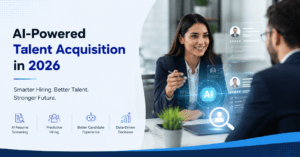
The recruitment landscape is evolving rapidly, and Artificial Intelligence (AI) is at the center of this transformation. In 2026, organizations are leveraging AI-powered talent acquisition strategies to streamline hiring processes, improve candidate experiences, and make more informed recruitment decisions.
As businesses face increasing competition for skilled professionals, AI has become a valuable tool for attracting, assessing, and retaining top talent. From resume screening to predictive hiring analytics, AI is helping companies reduce hiring time while improving the quality of hires.
What Is AI in Talent Acquisition?
AI in talent acquisition refers to the use of machine learning, automation, and data-driven technologies to support and optimize recruitment activities. These technologies can analyze large volumes of candidate data, identify suitable applicants, automate repetitive tasks, and provide insights that help recruiters make better hiring decisions.
Rather than replacing recruiters, AI enhances their capabilities by allowing them to focus on strategic and relationship-driven aspects of hiring.
Key Ways AI Is Transforming Recruitment in 2026
1. Automated Resume Screening
One of the most time-consuming tasks in recruitment is reviewing hundreds of resumes for a single position. AI-powered recruitment tools can quickly analyze resumes, identify relevant skills, qualifications, and experience, and rank candidates based on job requirements.
This enables recruiters to focus on the most qualified applicants and significantly reduces time-to-hire.
2. Skills-Based Hiring
In 2026, organizations are increasingly prioritizing skills over traditional qualifications. AI-driven assessment platforms evaluate candidates based on technical skills, competencies, and job readiness rather than solely relying on degrees or past job titles.
Skills-based hiring helps employers discover hidden talent and build more diverse and capable teams.
3. Predictive Hiring Analytics
AI can analyze historical hiring data and workforce trends to predict which candidates are most likely to succeed in a role. Predictive analytics helps organizations make data-backed hiring decisions, reduce employee turnover, and improve workforce planning.
This approach allows businesses to identify high-potential candidates before competitors do.
4. Enhanced Candidate Experience
Candidate experience has become a critical factor in employer branding. AI-powered chatbots and virtual assistants provide instant responses to candidate queries, schedule interviews automatically, and keep applicants informed throughout the recruitment process.
A smooth and responsive hiring experience increases candidate engagement and improves employer reputation.
5. Bias Reduction in Hiring
When implemented responsibly, AI can help reduce unconscious bias by evaluating candidates based on objective criteria such as skills, experience, and performance assessments.
Organizations are increasingly using AI tools to support fair and inclusive hiring practices while ensuring compliance with diversity and inclusion goals.
6. Personalized Recruitment Marketing
AI enables recruiters to create highly targeted recruitment campaigns based on candidate preferences, behavior, and career interests. Personalized communication helps attract passive candidates and increases application conversion rates.
As recruitment becomes more competitive, personalized engagement is becoming a key differentiator.
Benefits of AI-Powered Talent Acquisition
Organizations adopting AI recruitment solutions are experiencing several advantages:
- Faster hiring processes
- Improved quality of hires
- Reduced recruitment costs
- Better candidate engagement
- Enhanced workforce planning
- Increased recruiter productivity
- More accurate hiring decisions
- Scalable recruitment operations
These benefits allow businesses to remain agile in an increasingly competitive talent market.
Challenges Organizations Should Consider
While AI offers significant advantages, successful implementation requires careful planning. Companies should focus on:
- Maintaining transparency in hiring decisions
- Protecting candidate data and privacy
- Regularly auditing AI systems for fairness
- Combining AI insights with human judgment
- Ensuring compliance with employment regulations
The most effective recruitment strategies combine advanced technology with experienced recruiters who understand organizational culture and business needs.
The Future of Talent Acquisition
As AI technology continues to advance, talent acquisition will become more predictive, personalized, and efficient. Future recruitment systems will provide deeper insights into candidate potential, workforce trends, and hiring outcomes.
Organizations that embrace AI-powered recruitment today will be better positioned to attract top talent, improve hiring efficiency, and build future-ready workforces.
AI is no longer a competitive advantage—it’s becoming a fundamental component of modern talent acquisition strategies.
Frequently Asked Questions (FAQ)
How is AI used in talent acquisition?
AI is used for resume screening, candidate matching, interview scheduling, predictive analytics, recruitment marketing, and improving candidate experiences.
Can AI replace recruiters?
No. AI automates repetitive tasks and provides data-driven insights, but human recruiters remain essential for relationship building, cultural assessment, and strategic decision-making.
What are the benefits of AI recruitment?
Benefits include faster hiring, improved candidate quality, lower recruitment costs, better candidate engagement, and enhanced hiring accuracy.
Is AI hiring fair?
When designed and monitored properly, AI can help reduce unconscious bias by focusing on objective qualifications and skills rather than subjective factors.
Why is AI important for recruitment in 2026?
AI helps organizations address talent shortages, improve hiring efficiency, and make data-driven recruitment decisions in an increasingly competitive job market.
For more information about AI-driven talent acquisition, IT staffing, recruitment solutions, and workforce transformation, visit 3ShoolTech.
This article answers:
- How is AI transforming talent acquisition in 2026?
- What are the benefits of AI in recruitment?
- How does AI improve hiring decisions?
- Can AI replace recruiters?
- What is skills-based hiring?
- How do companies use AI for recruitment?
- What are the latest recruitment trends in 2026?